IAQ BOX - Low-Power IoT Air Quality Monitor
5 Apr 2022
Overview
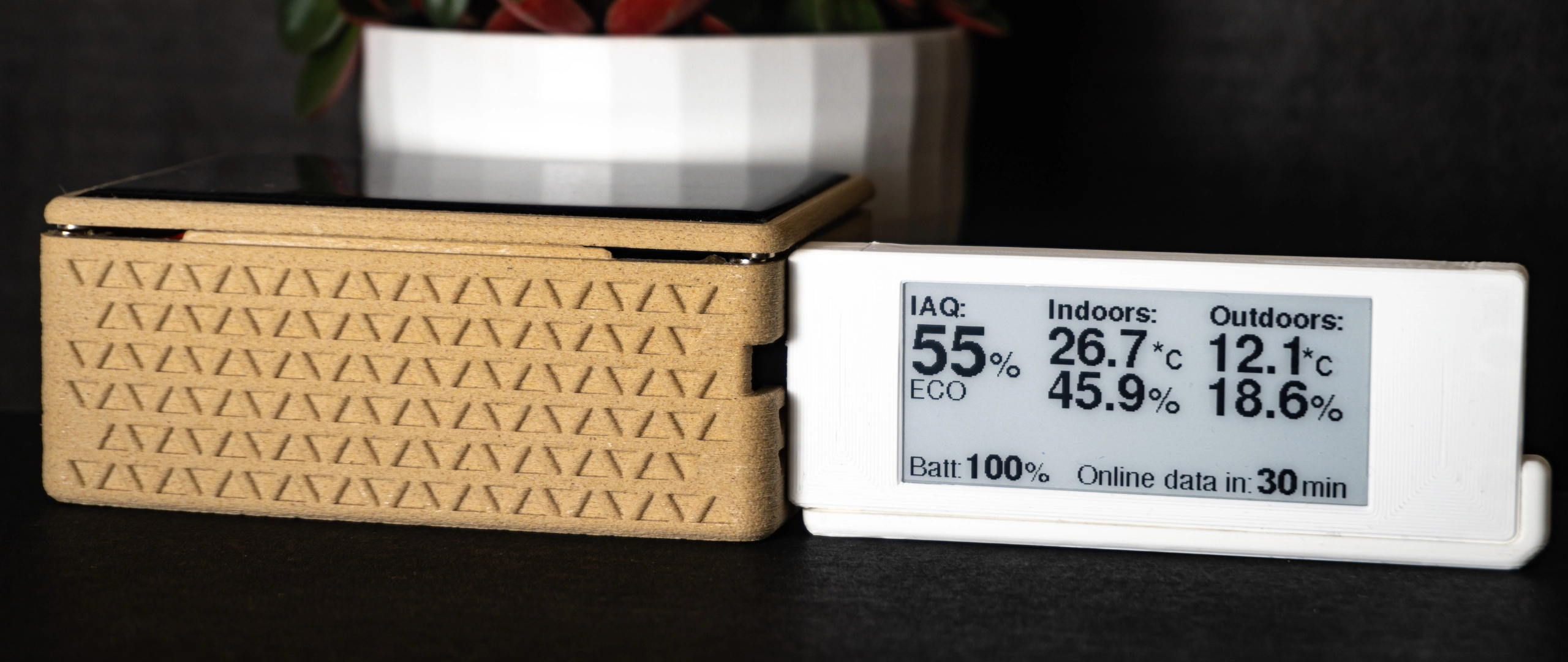
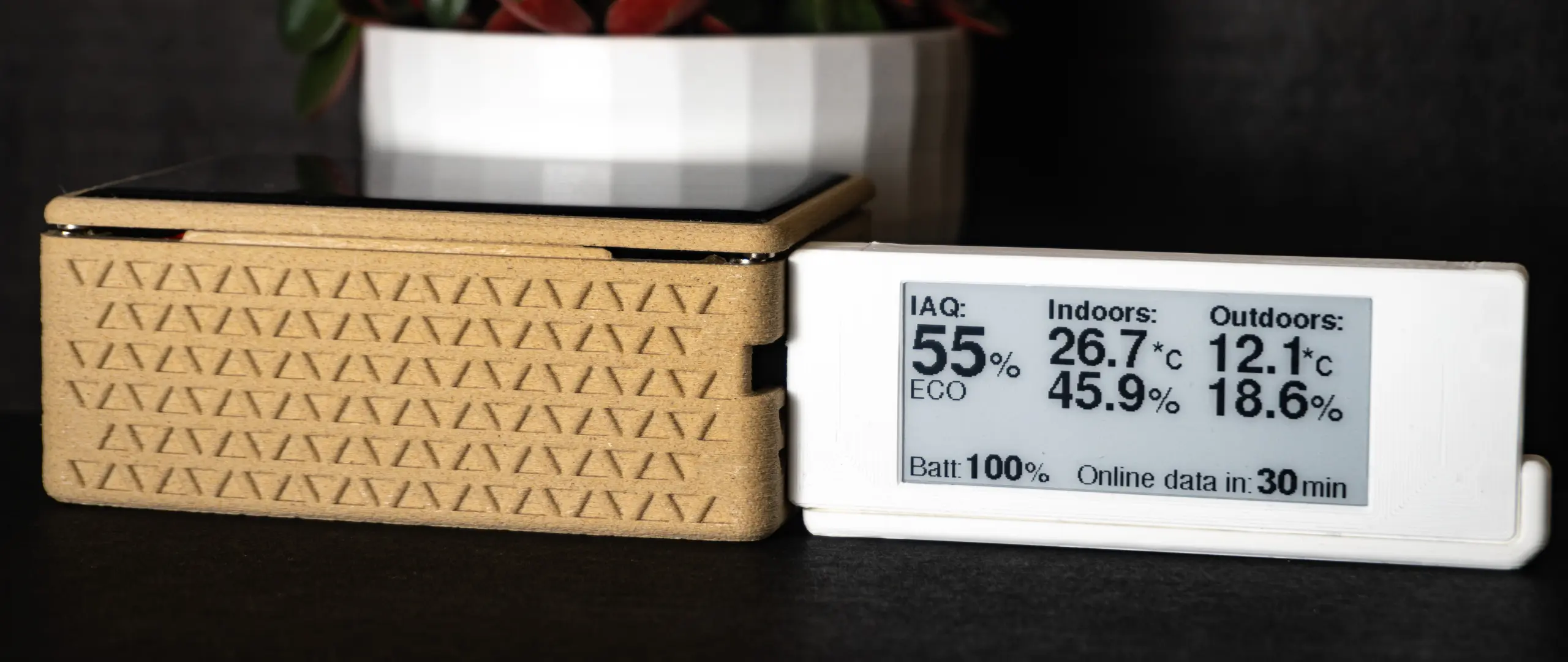
IAQ BOX is a low-power IoT device that measures air quality (temperature, humidity, air pressure and VOC level) with a Bosch BME680 sensor. The E-Ink display keeps showing the data without drawing power, while solar charging makes the device fully self-sufficient. It was designed for low-power operation and can be integrated into smart home systems over the ESP-NOW protocol.
Technical implementation
Hardware design
- Custom PCB: designed in EasyEDA to make the connections simpler and safer:
- ESP8266 (D1 Mini v4.0): an affordable Wi-Fi module on a carrier shield, which avoids having to solder SMD connectors.
- HT7833 linear voltage regulator: minimal quiescent current and a low dropout voltage.
- TP4056 charge controller + DW01A battery protection chip: essential for handling the high-capacity battery pack safely.
- PH2.0/SH1.0 connectors: reliable connections for the E-Ink display and the sensors.
- Power system:
- 4× 18650 Li-ion cells in a 1S4P configuration.
- 5 V 250 mA solar panel: the largest panel that was practical for charging.
- 3D-printed enclosure:
- Wood-filled PLA filament: an enclosure that smells like wood and has a rough texture.
- Magnetic mounting system: easy assembly and an electrical connection to the solar panel.
Software architecture
- Power-saving firmware:
- Deep sleep: the device only syncs on every 6th run, which brings the average current draw down to 2.5 mA.
- Data kept in RTC memory: readings survive deep sleep, because the RTC memory stays powered.
- ESP-NOW communication: a power-efficient peer-to-peer link to an IAQ BRIDGE device that acts as a gateway.
- Cloud integration:
- Adafruit IO: real-time data visualization and history.
- MQTT: lightweight IoT messaging.
- Fault tolerance:
- Automatic recovery when the connection drops.
- Sensor diagnostics and error handling.
- Battery health monitoring based on voltage thresholds.
Key features
- Power-saving display: a 2.9-inch E-Ink display that shows data without consuming power.
- Self-sufficient: with enough light, solar charging gives it practically unlimited runtime.
- Modular design: magnetic mounts and connectors make it easy to swap sensors and displays.
- Smart home compatible: integrates with Home Assistant and other IoT platforms.
- Cheap to build: all parts together cost less than
30 000HUF.
Technologies
- Embedded systems: ESP8266, FreeRTOS (Arduino Core).
- Protocols: ESP-NOW, MQTT.
- Cloud services: Adafruit IO.
- CAD tools: EasyEDA (PCB design), Fusion 360 (3D modeling), Cura (3D printing).
- Power management: linear voltage regulators, lithium battery management.
- Data visualization: E-Ink.
Results
- First place at SZIIV 2022
- 9.32 mW average power consumption
- 225 days of runtime
- E-Ink display
- ESP-NOW integration
- Demo video
Back to projects